
When wanting to look smart gets in the way of learning
Note: This project was in collaboration with Dr. Alex Shaw (University of Chicago). You can read the full paper (published in Child Development) here, and you can find our Scientific American article on the research here.
At some point or another, we’ve probably all wanted to others to think we’re smart. The irony about wanting to seem smart, though, is it can often lead us to avoid behaviors that would actually help us learn and grow. A student in school might opt not to seek help when they need it out of fear that it would make them seem less intelligent. A professional in the workplace might hold back a question in a meeting to avoid revealing confusion or a gap in knowledge. This dynamic shows up across many contexts; yet little is known about when this particular kind of reputation management begins in childhood.
To explore this question, we ran five studies with 576 four- to nine-year-old children. We presented children with scenarios and asked them to predict how someone who wants to “seem” smart would behave compared to someone who wants to “be” smart. We found that, increasingly with age, children predicted the child who wants to seem smart would be more likely to lie to cover up failure, but less likely to downplay success (see first figure below). With age, children also thought that the child who wants to seem smart would be less likely to seek help publicly (i.e., in a classroom where peers were present) than privately (i.e., on a computer where no one else was present; see second figure below).
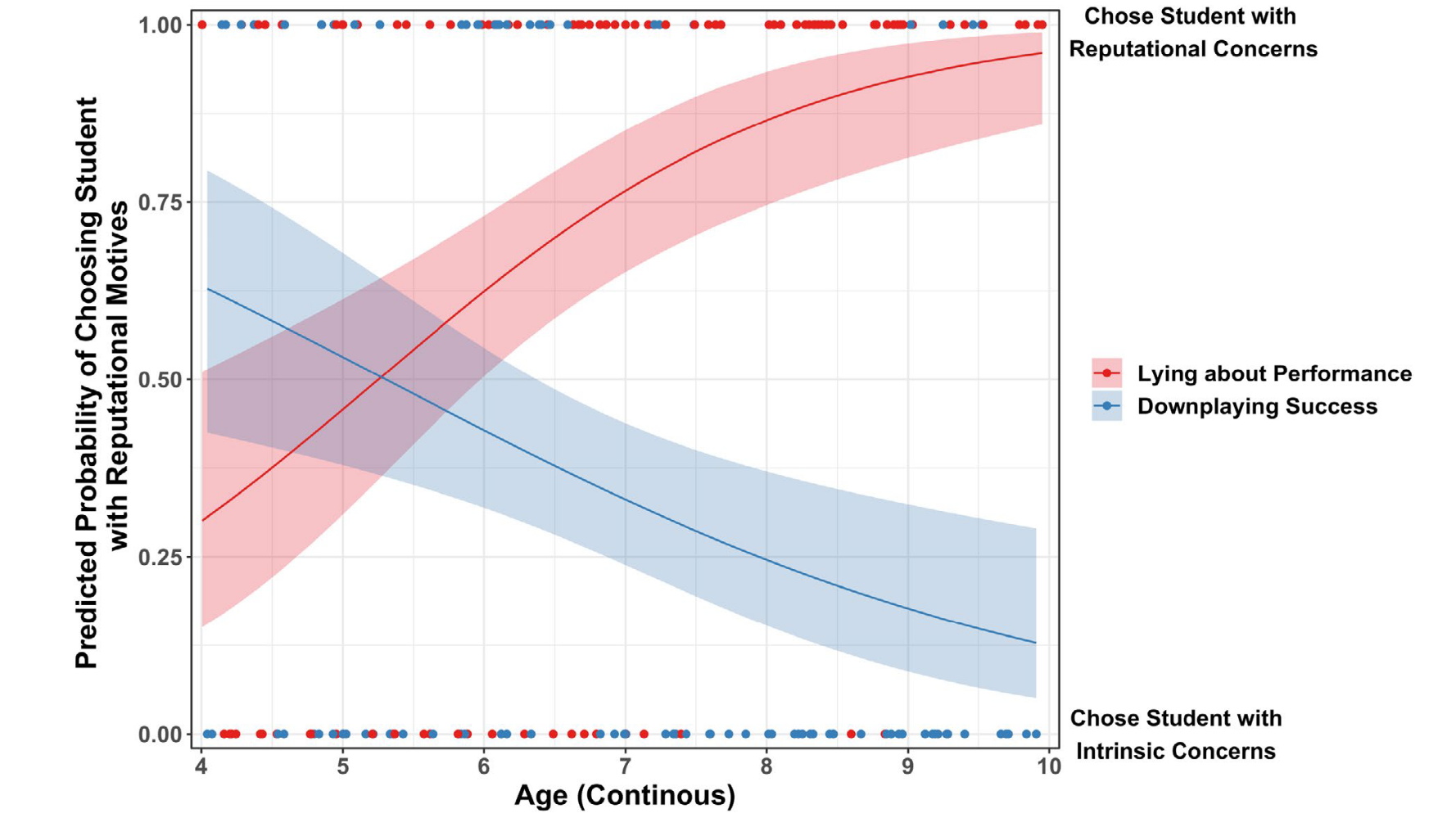
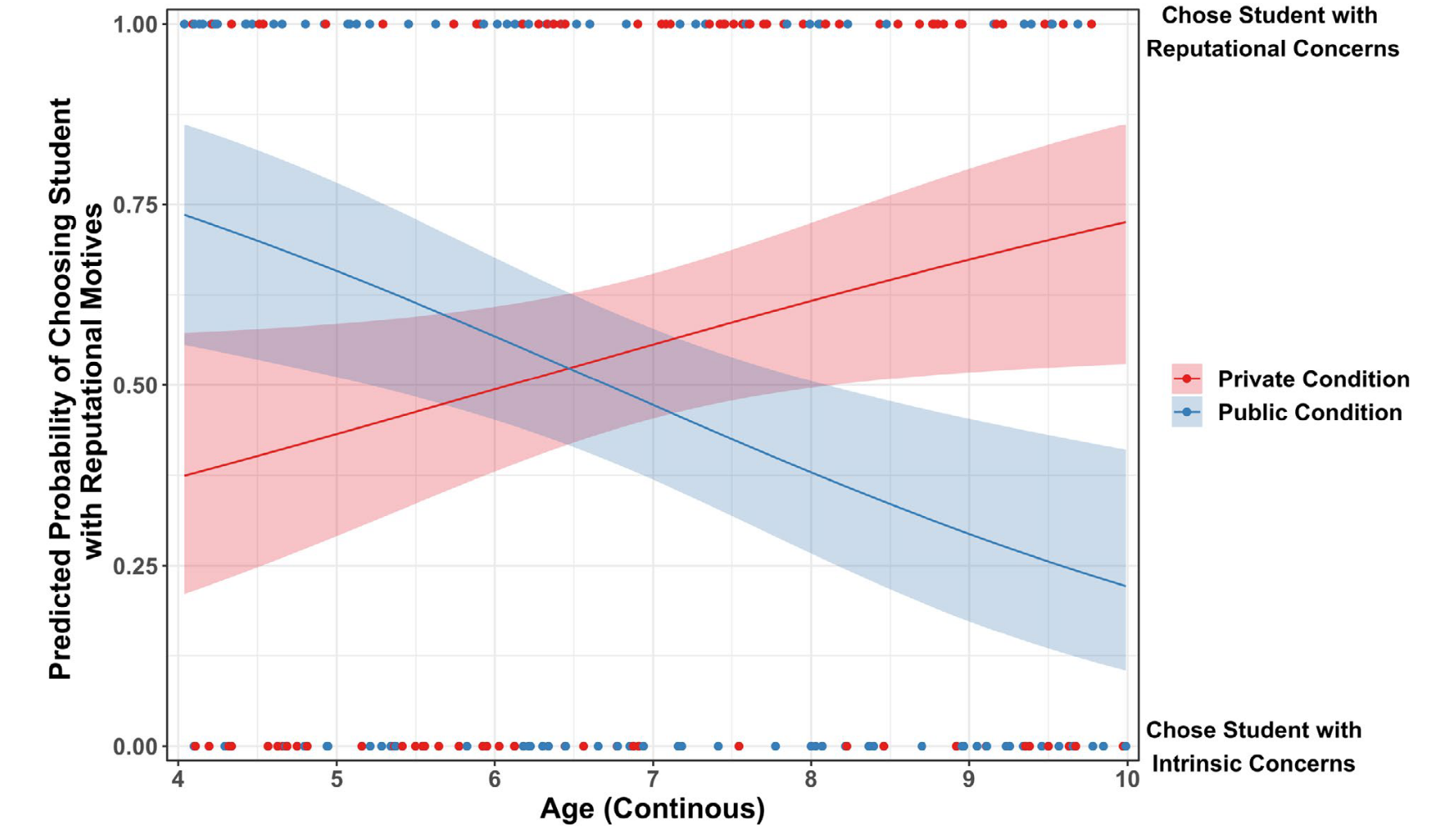
Taken together, these findings suggest that, as children get older, they increasingly recognize what kinds of behaviors one is likely to engage in (e.g., talking up successes) or avoid (e.g., public help-seeking) in order to seem smart. Most of these predictions began to emerge by age 7; this means that, by the first grade, children are starting to show adult-like reasoning about how reputational pressures are likely to shape someone’s behavior.
While our paradigm did not directly evaluate children’s own reputation management behaviors, other evidence from the developmental literature suggests that children often begin to manage their reputations before they can explicitly reason about them (Zhao et al., 2017). Thus, it’s possible that children might be shifting their own learning behavior due to concerns about seeming smart even before age 7.
All of this raises an important practical question: how do we design learning environments that take reputational concerns into account? One option is to offer more opportunities for “reputationally risky” learning behaviors – e.g., seeking help, asking questions – in private. For example, teachers (or even managers) might consider setting up a “questions box” that allows individuals to write their questions down and submit them anonymously. AI tools also present a unique opportunity here, as they can allow someone to get help without having to even involve another person.1 Creating spaces where help can be sought without reputational risk could be a helpful starting point, especially for those who otherwise might not feel comfortable engaging in these learning behaviors.
But at the same time, not all help-seeking or question-asking can or should be anonymous. When someone asks for help, it provides those teaching them with important data. Additionally, the less people seek help or ask questions publicly, the more the existing stigma against these behaviors gets reinforced (and the less everyone learns). Ideally, we need to lower the reputational cost of these behaviors in the first place so that kids (and even adults) feel encouraged to engage in them, even when others are present. We can start by simply normalizing seeking help, asking questions, etc. For instance, teachers could create activities where children need to seek help or ask questions of peers (e.g., an activity where each student becomes an “expert” on a different topic so that students must ask their peers questions in order to learn all of the material).
Another effective strategy could be to reframe learning behaviors in a more positive light. Being smart doesn’t always look like knowing everything; it can also look like knowing when there’s a gap in one’s knowledge – and asking the questions needed to fill the gap. Asking questions and seeking help publicly can also be construed as prosocial. Often, when we don’t know something, we aren’t the only ones; asking a question publicly means that everyone else also gets to hear the answer and learn. Explicitly framing help-seeking and question-asking as intellectually humble and helpful – and offering praise when someone engages in these behaviors – could help shift the perception of these behaviors so that they’re no longer seen as reputationally risky, but rather as reputationally beneficial.
Reputational concerns start early and can have a profound impact on learning. But designing learning and achievement contexts with this in mind presents an opportunity to create spaces where people can feel encouraged to fully engage in the learning process.
1 There is emerging evidence that some young people are already turning to AI instead of other humans for help with homework (among other things). In a 2026 survey of 9- to 17-year-olds, 23% of youth reported that they would ask an AI chatbot for help with schoolwork or homework before they would go to a trusted adult (O’Neil et al., 2026). This number was even higher among 16- to 17-year-olds (38%). While these findings indicate that the majority of young people are still going to adults for help first, it is still striking that so many are turning to AI – this could, in part, reflect a desire to learn without incurring reputational risks. Future research should explore a potential relationship between reputational concerns and turning to AI tools for help.