
When help becomes too much: What overhelping can convey
Note: These projects were a part of my dissertation work at Stanford and were done in collaboration with my PhD advisors, Drs. Ellen Markman and Carol Dweck.
Help is ubiquitous in everyday life, yet it can be deceptively difficult to calibrate. Providing too little help can lead to unproductive struggle, while providing too much help (or “overhelping”) can undermine independence and genuine growth. This tension between not enough and too much help plays out across contexts: within families, in classrooms, and increasingly, in how AI systems respond to users. To address this issue, we need to understand why different types of help can thwart growth; that is, what makes some forms of help empowering and others dejecting?
Across eight studies, this project specifically explored what messages overhelping might send about those receiving such help. Overhelping is especially insidious because help can often feel like a good thing, and so, at first glance, providing more help might seem better than providing less help. However, past research suggests that overhelping can reduce behavioral markers of motivation, such as persistence in the face of difficulty (Leonard et al., 2019). Here, we dug into the mechanisms underlying why overhelping might dampen motivation (and why someone might overhelp in the first place). Our research questions were:
- What messages might overhelping communicate?
- What beliefs predict endorsement of overhelping?
- Do those most likely to overhelp recognize the messages they’re sending?
Overhelping can convey negative messages about competence
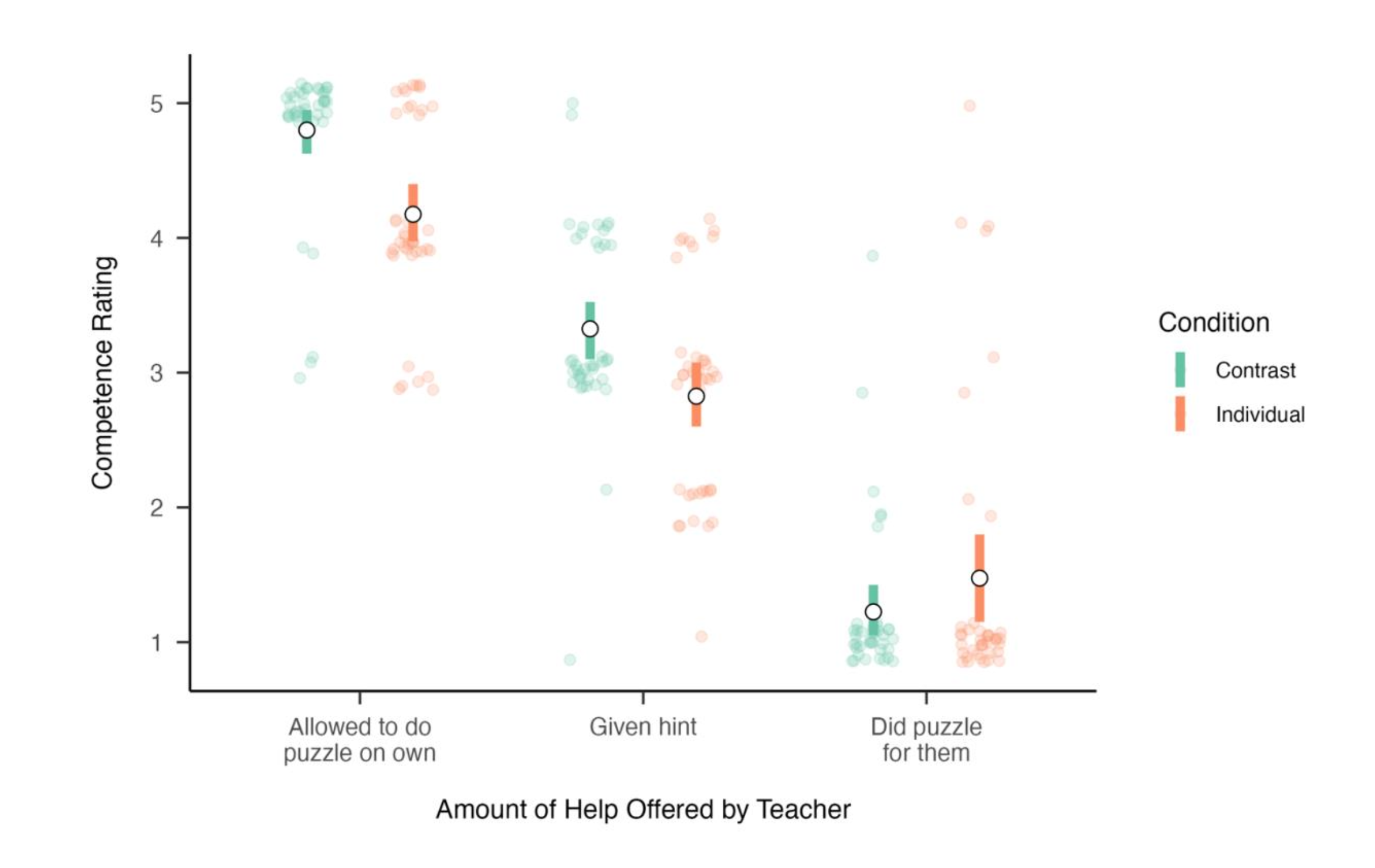
In our first set of studies, we presented adult participants with scenarios where a teacher provided students working on the same task – a puzzle – with different amounts of help. One student was given no help and was allowed to do the puzzle on their own, another student was given a hint, and another student was overhelped (that is, the teacher stepped in to do the puzzle for them).
We found that more help signaled lower competence. The more help a teacher provided a student, the less competent they were judged to be. This was especially true when participants saw a direct contrast in the amount of help different students were provided; participants who only saw one of these student-teacher interactions still assumed that those who received more help were less competent, but the differences between conditions were less pronounced (see figure below). It seems that providing more help, especially when it’s clear that others received less help, can – even inadvertently – send negative messages about the recipient’s competence.
We also found that help sent messages about the teacher’s mindset about students’ abilities. Specifically, when participants saw the teacher overhelp a student (either in isolation or in contrast with students who received less help), they believed the teacher was conveying that only some – not all – students can become good at doing puzzles. This suggests that overhelping doesn’t just convey something about the recipient’s competence at that moment; it can communicate something deeper about the very nature of their competence.
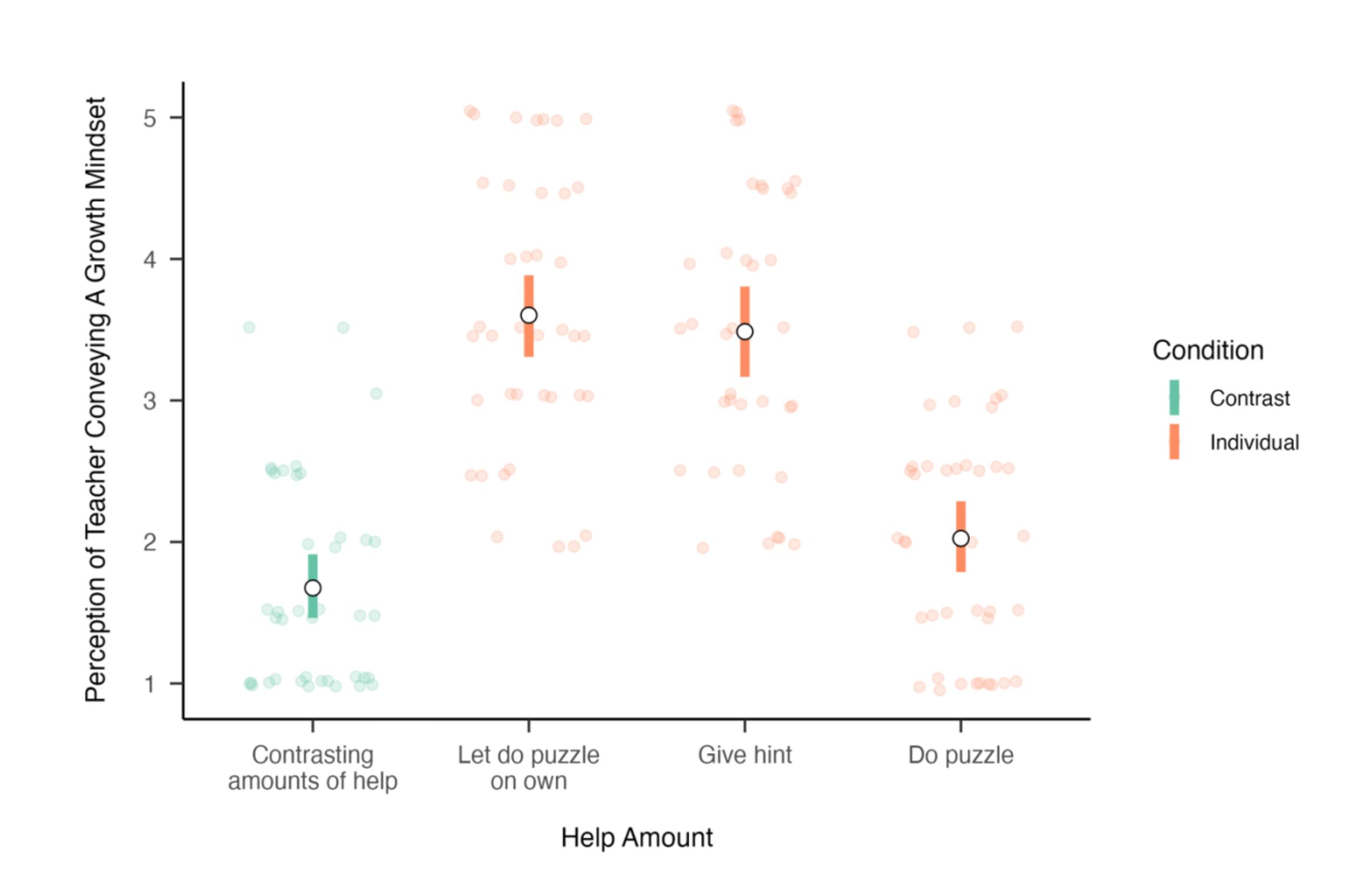
Based on these findings, one might assume it’s best to adopt a policy of just avoid providing a lot of help in general. But sometimes, we need to provide more help; for instance, when we’re teaching someone how to do something for the first time, we might need to do the task for them a few times so they can build a conceptual foundation, learn the overall shape of the process, etc. In a follow-up study, we explored how we might prevent such help from sending a negative message. We found that what was most effective was providing a specific rationale. In the puzzle case, this looked like saying, “Here, let me do the puzzle to show you how.” This might feel simple, but this clear expression of a pedagogical intention was powerful: participants no longer felt that the teacher was conveying a fixed mindset about students’ abilities. Calibrating help can be challenging, but the help itself doesn’t have to stand alone – a clear reason for the help can go a long way.
What drives overhelping
The fact that overhelping can not only dampen motivation but also send negative messages about competence makes it even more important to understand why people might overhelp in the first place. Of course, overhelping can occur for many reasons (e.g., a lack of information about the recipient’s current level of knowledge). But some helpers systematically overhelp – why might this be?
One domain where systematic overhelping comes up frequently is parenting. The discourse on “helicopter” or “snowplow” parenting reveals a potential reason why: a belief that, in order for children to succeed, parents must intervene and do things on behalf of their children (as an example, see this New York Times article titled, The Bad News about Helicopter Parenting: It Works.)
We developed a measure to assess such beliefs and directly investigated whether a belief that parents need to intervene (even by the time their children should be more independent, i.e., during young adulthood) predicted specific manifestations of overhelping, such as doing a school project entirely for one’s child. Our research confirmed this relationship and, surprisingly, found that it held even in cases where a child was already excelling academically. This suggests that overhelping isn’t always a miscalibration – and sometimes it isn’t about the needs of the recipient at all. Sometimes, it’s a reflection of the helper’s beliefs about what leads to a successful outcome.
Do overhelping parents recognize what such help conveys?
Overhelping parents might overhelp systematically because they believe it’s necessary – but do they realize the impact it has? We explored this question in further research with parents and found that the answer is, at least to some extent, no.
We gave parents our novel belief scale and then, a week later, asked them to consider a scenario where a parent overhelped their high-school aged child and did a project on their behalf. The more a parent believed that they needed to intervene, the more positively they thought the child in the scenario would react to their parent’s help and the less they thought such overhelp would convey a fixed mindset. These findings suggest that those most inclined to overhelp may be the least aware of the negative implications of doing so.
Implications
Finding the “sweet spot” where help is supportive – yet capacitating – can feel elusive, yet it is vital if we want help to be an opportunity for learning and growth. Overhelping can send negative messages about the recipient’s competence; such messages have the power to reverberate well beyond a particular instance of help. Importantly, though, it is possible to provide a lot of help without necessarily activating such messages. For instance, a clearly stated, specific rationale can be surprisingly powerful in conveying that help does not reflect fixed beliefs about the recipient’s abilities, but rather a desire to facilitate their learning.
The insights from this work of course extend to typical achievement contexts, such as the classroom and the workplace. But they also might be useful elsewhere – for instance, in considering how to design and build AI systems that support capacity building. AI often gives us a full answer without a user necessarily asking for it. While this could be construed as helpful, it also can take away opportunities for learning (Shen & Tamkin, 2026) and could even start to erode users’ sense of competence. Over time, this could lead to a vicious cycle, one where users feel less confident tackling problems on their own, thus motivating them to offload more of their work to AI. This is especially concerning considering the early evidence that college students might be especially likely to turn to an LLM for higher-order cognitive functions, such as creating and analyzing (Handa et al., 2025).
Joining a growing body of work suggesting the importance of incorporating growth mindset and similar principles into LLMs (Demszky & Liu, 2023; Handa et al., 2023), I propose that we should also incorporate insights from the literature on help. Like the teacher who does a puzzle for their student, AI tools tend to overhelp. Instead, perhaps they should approach things more like the teacher who scaffolds with a hint or the teacher who pairs help with a pedagogical rationale. Something that is especially powerful about AI in particular is that it can often go beyond what humans are capable of; within the domain of help, this means they have nearly endless capacity to iterate and flexibly adapt to a learner over time based on the learner’s explicit feedback as well as implicit cues from their behavior.
Designing to maximize these strengths could help users grow from their interactions with AI, rather than pushing them toward offloading their thinking. Of course, calibrating and contextualizing help is not a simple task, for humans or AI. But exploring how we can effectively do so is worthwhile: it can mean the difference between someone feeling incapable and someone feeling prepared to tackle the next challenge.